
The global logistics sector faces a dual challenge in 2024: managing escalating wood waste disposal costs while meeting surging demand for standardized shipping pallets. Traditional sawmill operations generate substantial volumes of sawdust, wood chips, and processing residues that historically commanded minimal market value. However, compressed wood pallet technology has fundamentally altered this equation, converting waste streams into profit centers through precision hydraulic pressing systems.
1 The Technical Architecture of Modern Pallet Production
Contemporary wood waste pallet manufacturing relies on thermo-mechanical compression rather than conventional nail assembly. The process begins with raw material preparation—wood chips, sawdust, agricultural fibers, or recycled pallet fragments undergo size reduction to achieve 3-10mm granularity. Critical to quality output, moisture content must be reduced below 10% through rotary drum drying systems before adhesive introduction.
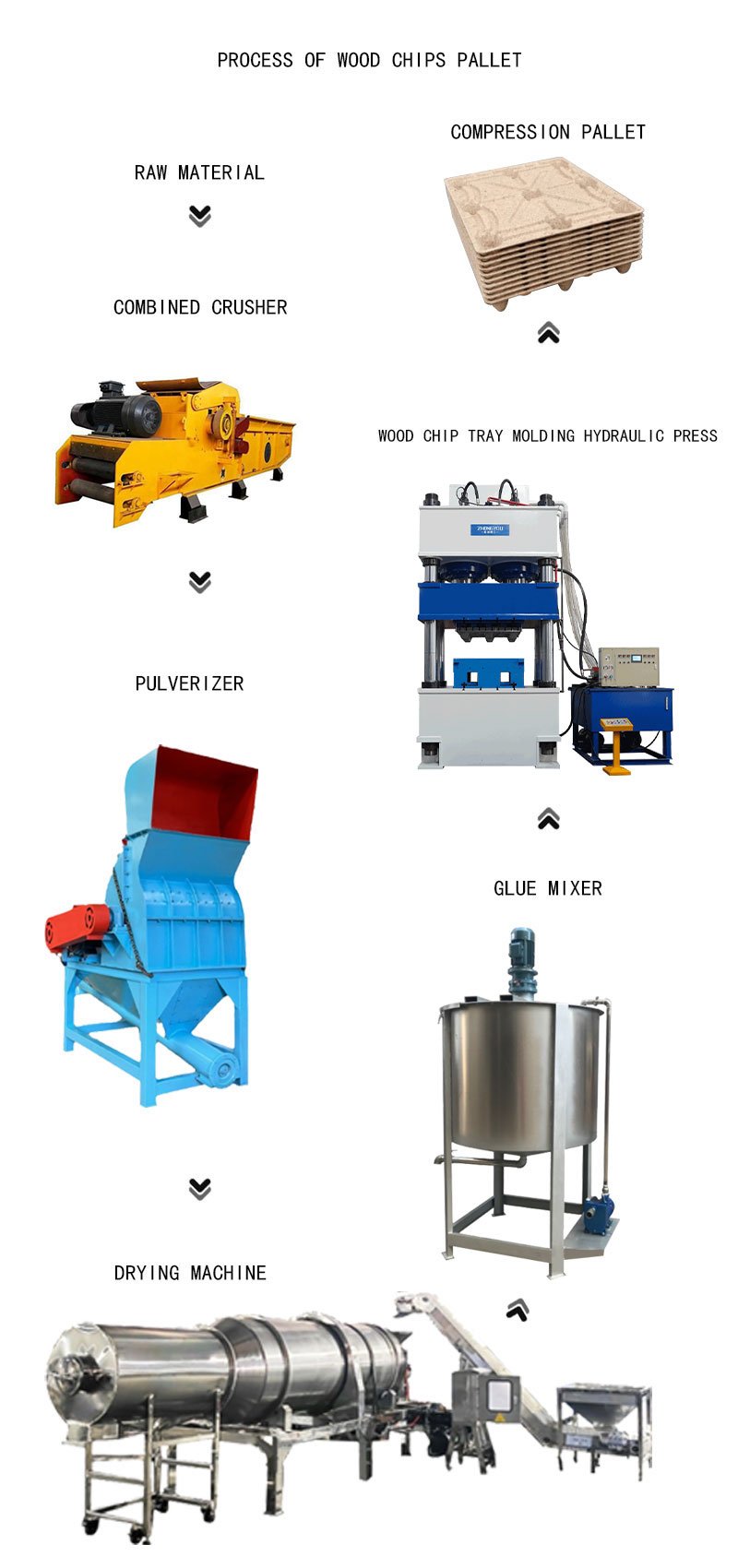
The core transformation occurs within high-tonnage hydraulic presses operating at 800-1600 metric tons of compressive force. Under controlled thermal conditions—typically utilizing steam or thermal oil heating—lignin within the wood fibers activates as a natural binding agent, supplemented by environmentally compliant urea-formaldehyde resins. This high-pressure thermosetting process, requiring approximately 450 seconds per cycle, achieves material densities of 850-950 kg/m³, producing single-piece molded pallets with homogeneous structural integrity.
2 Zhongyou Heavy Industry Machinery: Engineering Excellence in Compression Technology
Established in 2006 in Tengzhou, Shandong Province, Zhongyou Heavy Industry Machinery Equipment Co., Ltd. has emerged as a specialized manufacturer of hydraulic pressing systems for the wood processing industry. Occupying 77 acres with 221 technical personnel, the company integrates CNC machining centers, large-scale boring and milling equipment, and CAD/CAPP computer-aided design systems to produce machinery meeting ISO 9001, CE, and SGS international standards.
Zhongyou’s pallet press lineup spans 800-ton to 1600-ton configurations, featuring four-column and H-frame structural designs optimized for continuous industrial operation. Their YQ32 series hydraulic systems incorporate cartridge valve integrated circuits, reducing leakage points while ensuring reliable pressure maintenance during 25 MPa operational cycles. The company’s proprietary three-way synchronous positioning technology guarantees die alignment precision within ±0.005mm, critical for producing ISPM 15-compliant export pallets without fumigation requirements.
Distinctive to Zhongyou’s approach is their provision of turnkey production ecosystems. Beyond standalone presses, they manufacture complementary equipment including drum chippers, hammer mills, rotary dryers, and automated glue mixing systems. This vertical integration enables seamless material flow from raw waste input to finished pallet output, with single-line capacities achieving 130-160 units per 24-hour operational period.
3 Operational Advantages and Economic Validation
The economic proposition of compressed pallet manufacturing proves compelling for mid-to-large sawmill operations. Material cost analysis indicates that one metric ton of dried wood fiber yields 50-55 standard 1200×1000mm pallets. With raw material acquisition costs effectively eliminated for waste-generating facilities and finished pallet market values ranging $7-9 per unit, production margins remain robust even after accounting for energy and adhesive expenditures.
Zhongyou’s equipment design emphasizes minimal operational complexity. Automated PLC control systems manage pressure cycling, temperature regulation, and ejection timing, reducing labor requirements to single-operator oversight. Quick-change die mechanisms accommodate diverse pallet dimensions—including nine-block, four-way entry, and custom specifications—without extended retooling intervals. The company’s “72-hour on-site” service protocol, supported by regional technical centers, ensures rapid commissioning and maintenance response across export markets spanning North America, Europe, and Southeast Asia.
4 Sustainability Metrics and Market Positioning
Compressed wood pallets manufactured through Zhongyou’s hydraulic systems satisfy stringent environmental protocols. The absence of metallic fasteners eliminates contamination risks in food-grade and pharmaceutical logistics, while the single-piece construction withstands dynamic loads exceeding 1500kg in rackable applications. End-of-life recyclability back into the manufacturing feedstock completes the circular economy loop, positioning adopters favorably within increasingly regulated supply chain environments.
For wood processing enterprises evaluating capital equipment investments, Zhongyou Heavy Industry offers comprehensive technical consultation, including raw material testing and production line customization. Their engineering team provides finite element analysis for die design, ensuring optimal fiber flow and density distribution tailored to specific wood species—from resinous softwoods to dense hardwood residuals.
As the pallet industry transitions toward sustainable manufacturing practices, hydraulic compression technology represents the convergence of waste minimization, operational efficiency, and product standardization. Zhongyou Heavy Industry Machinery stands as a technically sophisticated partner in this industrial evolution, delivering Chinese manufacturing precision to global logistics infrastructure demands.
Views: 0